Local SEO
How Reviews Impact HVAC Local Rankings: What Actually Moves the Map Pack (And What Doesn’t)
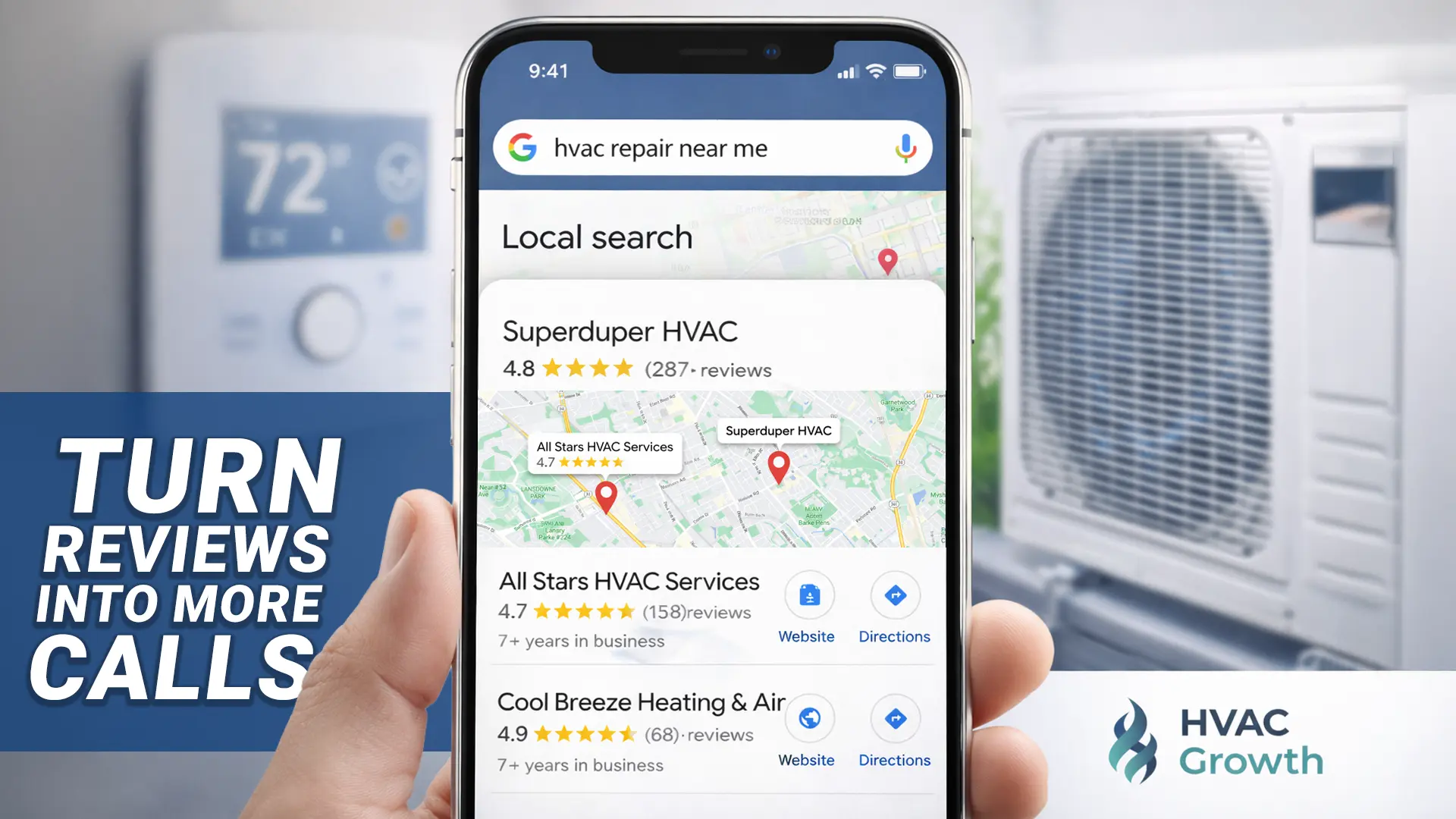
Reviews have become one of the most influential factors determining which HVAC contractors appear in the Google Map Pack—those three local results at the top of search that capture the majority of customer clicks and calls. For HVAC businesses specifically, this influence runs deeper than most industries because of how homeowners search when their furnace fails in January or their air conditioning stops working during a heat wave. They search with urgency, they search locally, and they make decisions fast. In that compressed decision window, your review profile often determines whether you get the call or your competitor does. Understanding exactly how Google weighs reviews, which review signals actually move rankings, and which common tactics backfire is essential for any HVAC contractor serious about sustainable local visibility.
Who This Article Is For (And Who It Isn’t For)
This article is written for HVAC contractors and business owners who want to understand the mechanism behind reviews and local rankings—not just that reviews “matter,” but specifically how Google uses them and what that means for your business strategy. If you’re looking for a clear framework to evaluate your competitive position and make informed decisions about reputation management, this is for you.
This article is not a step-by-step guide on how to ask customers for reviews, a template library for responding to negative feedback, or a troubleshooting guide for disappearing reviews. Those are separate topics that deserve their own focused treatment. Here, we’re focused on the ranking mechanism itself and how to think about reviews as part of a larger local visibility system.
Why Reviews Matter More in HVAC Than Most Industries
The HVAC industry operates under conditions that amplify the importance of reviews beyond what most service businesses experience. When a homeowner’s heating system fails, they’re not casually browsing—they’re in problem-solving mode with real urgency. This creates a compressed decision cycle where reviews function as the primary trust signal.
Consider the typical HVAC customer journey:
- Something breaks or stops working properly
- The homeowner searches “HVAC repair near me” or “furnace repair [city]”
- Google displays the Map Pack with three local results
- The homeowner scans star ratings and review counts in seconds
- They click on one or two options, skim recent reviews, and call
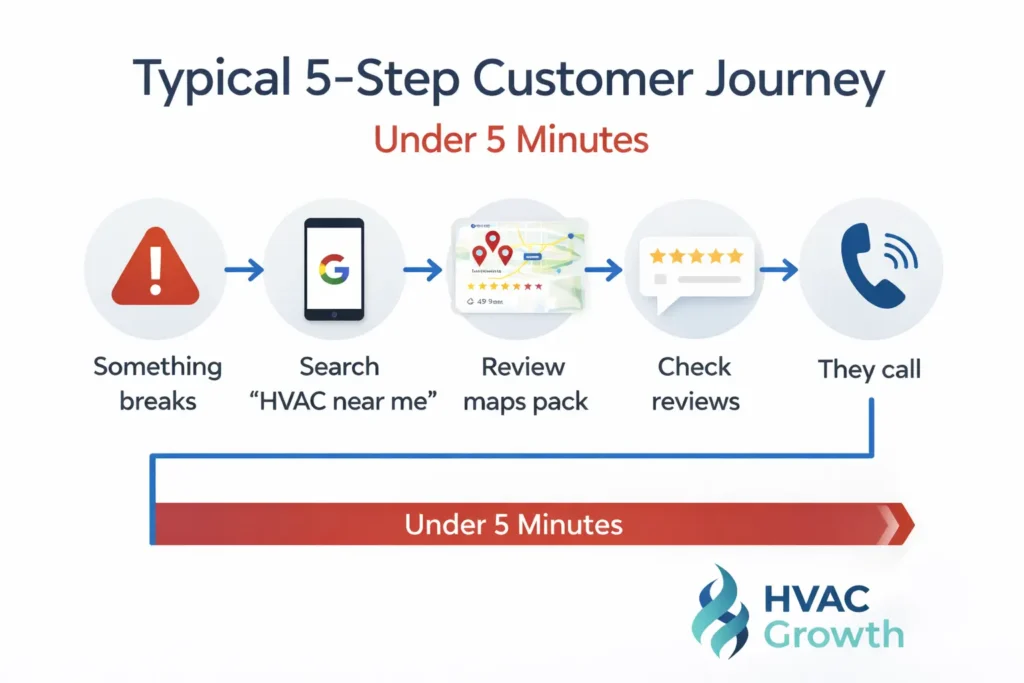
This entire process often happens in under five minutes. There’s no lengthy research phase, no comparison shopping across multiple visits. The decision happens fast, and reviews are doing heavy lifting at every stage—influencing whether you appear in the Map Pack, whether you get clicked, and whether that click converts to a call.
Research consistently shows that the vast majority of consumers check Google reviews before calling a local service business, and for high-trust services like HVAC where someone is entering a customer’s home and often recommending expensive equipment, that review check is nearly universal. Your review profile isn’t just marketing—it’s the first impression that determines whether you get the opportunity to serve that customer at all.
How Google Uses Reviews in Local Ranking
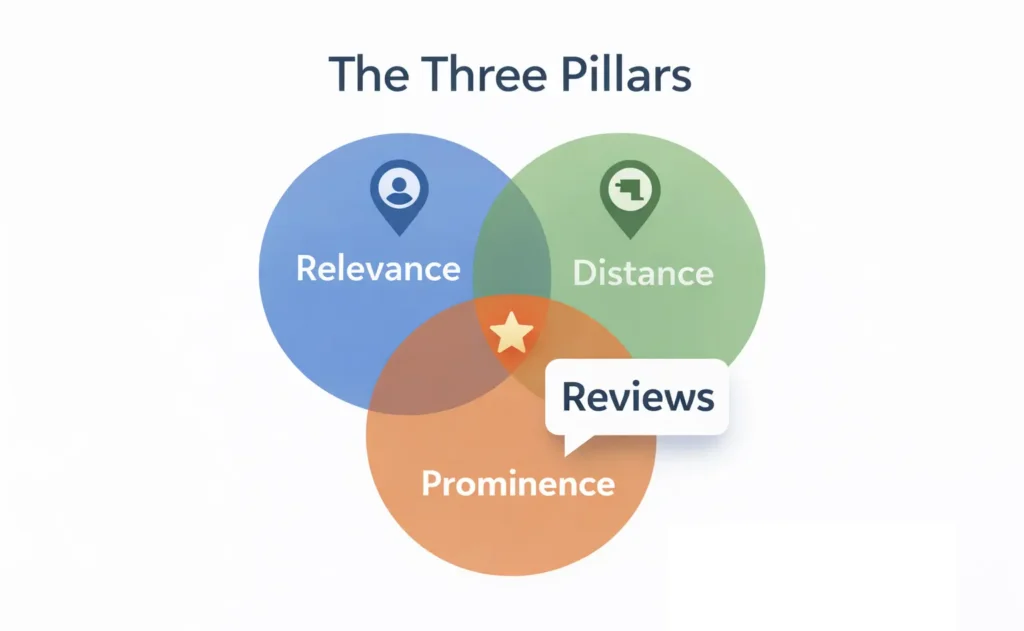
Google’s local ranking algorithm evaluates businesses across three primary factors: relevance, distance, and prominence. Understanding where reviews fit within this framework clarifies why they matter so much—and what they actually influence.
The Three Pillars of Local Ranking
Relevance measures how well your business matches what someone is searching for. This is largely determined by your Google Business Profile categories, your website content, and how clearly you signal the services you provide.
Distance is straightforward—how far your business location is from the searcher or the area specified in the search. This factor is essentially fixed; you can’t move your business closer to every potential customer.
Prominence reflects how well-known and trusted your business appears to be. This is where reviews exert their primary influence. Prominence considers your overall online presence, but reviews function as one of the strongest signals Google uses to evaluate whether a business is established, active, and trusted by customers.
Reviews as a Prominence Signal
When Google evaluates prominence, reviews provide several types of evidence:
- Business activity: A steady stream of reviews signals that you’re actively serving customers, not a dormant listing
- Customer validation: Positive reviews confirm that real people have used your services and found them satisfactory
- Market presence: Higher review counts suggest a more established presence in your service area
- Trust indicators: How you respond to reviews, particularly negative ones, signals professionalism and accountability
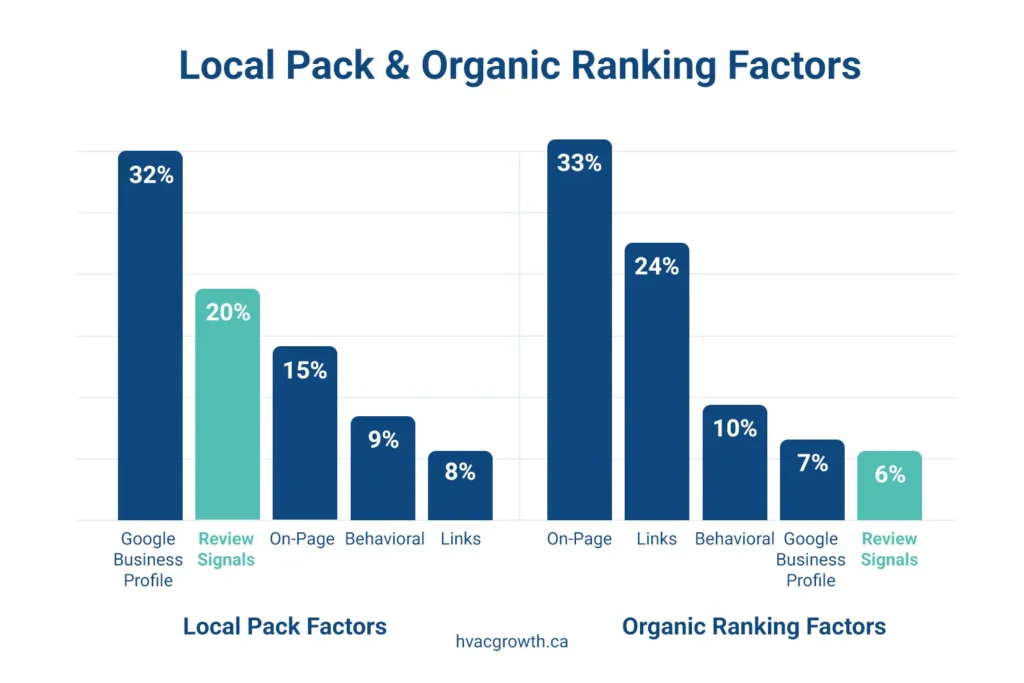
According to the most recent Local Search Ranking Factors research, review signals now account for approximately 20% of all Local Pack ranking factors—making them the second-most influential category after Google Business Profile signals. This represents a meaningful increase from previous years, indicating that Google has deliberately increased the weight assigned to customer feedback.
For HVAC contractors, this means reviews aren’t just nice to have—they’re a core ranking factor that directly influences whether you appear in the Map Pack alongside competitors.
The Five Review Variables That Actually Matter
Not all reviews are created equal in Google’s evaluation. Understanding the specific variables Google analyzes helps you focus on what actually moves the needle rather than chasing metrics that don’t matter.
1. Review Volume
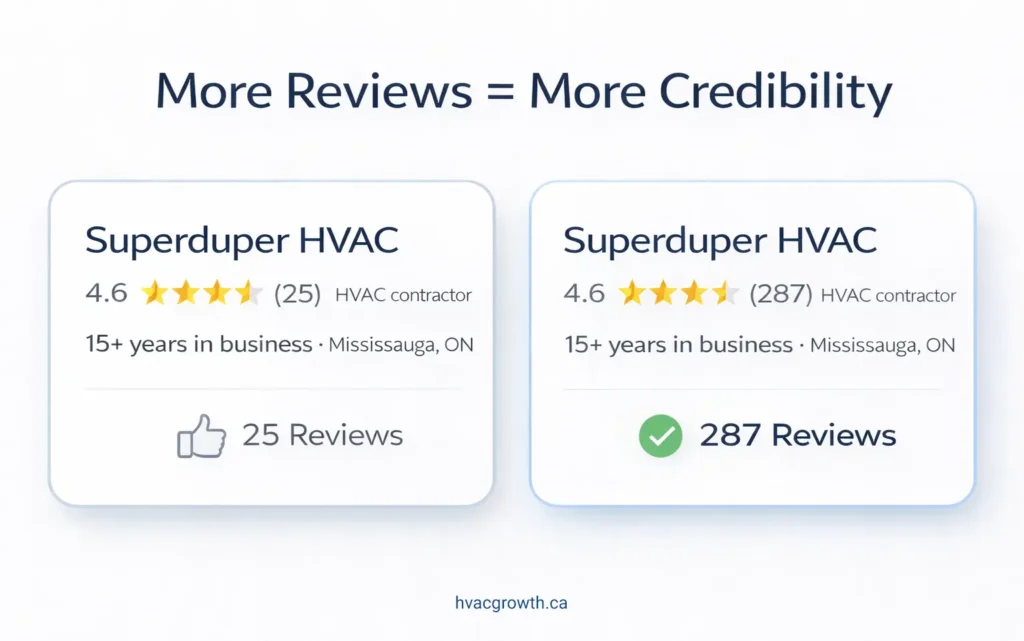
Total review count functions as a confidence indicator. When Google evaluates two HVAC contractors in the same area, the business with more reviews naturally appears more established. Industry data suggests that in competitive HVAC markets, top-ranking Map Pack results often have 80 or more reviews, while average Local Pack businesses typically maintain around 47 reviews.
However, volume is a threshold factor rather than an infinite scaling factor. The difference between 50 reviews and 150 reviews matters more than the difference between 150 and 300. Once you’ve established credible volume, other factors become more influential.
2. Review Velocity
Velocity—the pace at which new reviews arrive—has emerged as an increasingly important signal. Google clearly distinguishes between businesses receiving steady new reviews and those showing sporadic activity or stagnant profiles where recent feedback is months old.
The underlying logic is straightforward: ongoing review velocity signals that a business remains active and continues serving customers. An HVAC contractor receiving consistent new reviews demonstrates ongoing customer activity in ways that a large but stagnant review count doesn’t.
For HVAC contractors, this creates an important strategic consideration: a slow but steady stream of reviews generally outperforms long droughts followed by sudden floods. Google’s systems can detect unnatural review patterns, and sudden spikes—whether from aggressive asking campaigns or worse, purchased reviews—can trigger filtering or manual review.
3. Review Recency
Recent reviews carry more weight than older ones. A one-star review from three years ago impacts your profile far less than a one-star review from last month. Similarly, positive reviews from the past 30-90 days provide more ranking benefit than equally positive reviews from a year ago.
This recency factor compounds with velocity. Contractors who maintain systematic review generation processes keep their profiles “fresh” in Google’s evaluation, while competitors relying on sporadic feedback experience gradual visibility degradation as their reviews age.
4. Rating Distribution
Star rating matters, but not in the simplistic way many contractors assume. A 4.5-star average typically performs similarly to a 4.8-star average in terms of ranking, and both dramatically outperform ratings below 4.0.
What matters more than chasing a perfect 5.0 is consistency and authenticity. Profiles with ratings between 4.5 and 4.9 stars often appear more credible than pristine 5.0 profiles, both to Google’s algorithms and to human consumers. Some diversity in ratings—the occasional 4-star review among 5-stars—can actually increase trust perception.
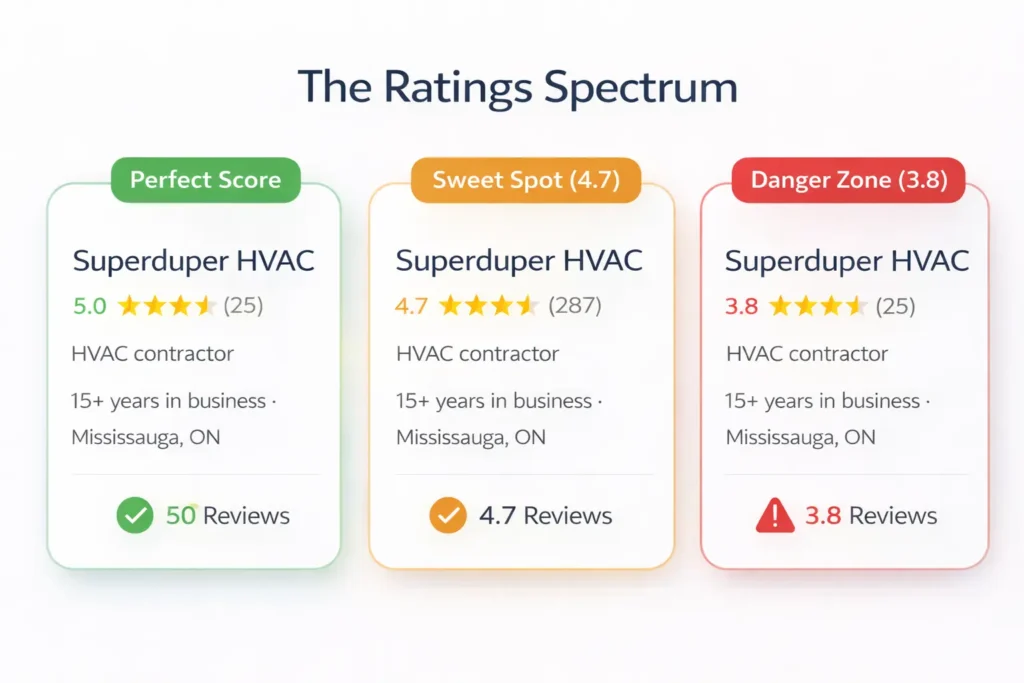
The real threshold to avoid: ratings below 4.0 stars create significant competitive disadvantages and signal consistent service quality issues.
5. Review Content
What customers actually write in their reviews increasingly influences Google’s understanding of your business. When reviews naturally mention specific services (“fast AC repair,” “professional furnace installation”), Google’s systems recognize these as customer validation that your business delivers these services.
However, this doesn’t mean you should ask customers to include specific keywords. We’ll address this myth directly below.
Review Velocity vs. Volume: The HVAC Reality
One of the most common mistakes we see HVAC contractors make is treating reviews as a one-time optimization project rather than an ongoing process. This leads to the “review push” approach: aggressive asking campaigns that generate a burst of reviews followed by months of silence.
This pattern creates several problems:
- Algorithmic suspicion: Sudden spikes in review activity can trigger Google’s spam filters, potentially resulting in review removal or profile penalties
- Recency decay: After the push ends, your most recent reviews age, and your profile appears increasingly stagnant compared to competitors with steady activity
- Missed opportunity: Every satisfied customer who leaves without being asked represents a lost review during the periods between pushes
The healthier approach treats review generation as an integrated part of your service delivery process—something that happens systematically after every job, not as a periodic marketing campaign. Contractors who implement this approach typically see 2-5 new reviews monthly, sometimes more during peak seasons, creating the steady velocity signal that Google rewards.
Do Keywords in Reviews Help? Myths and Safe Guidance
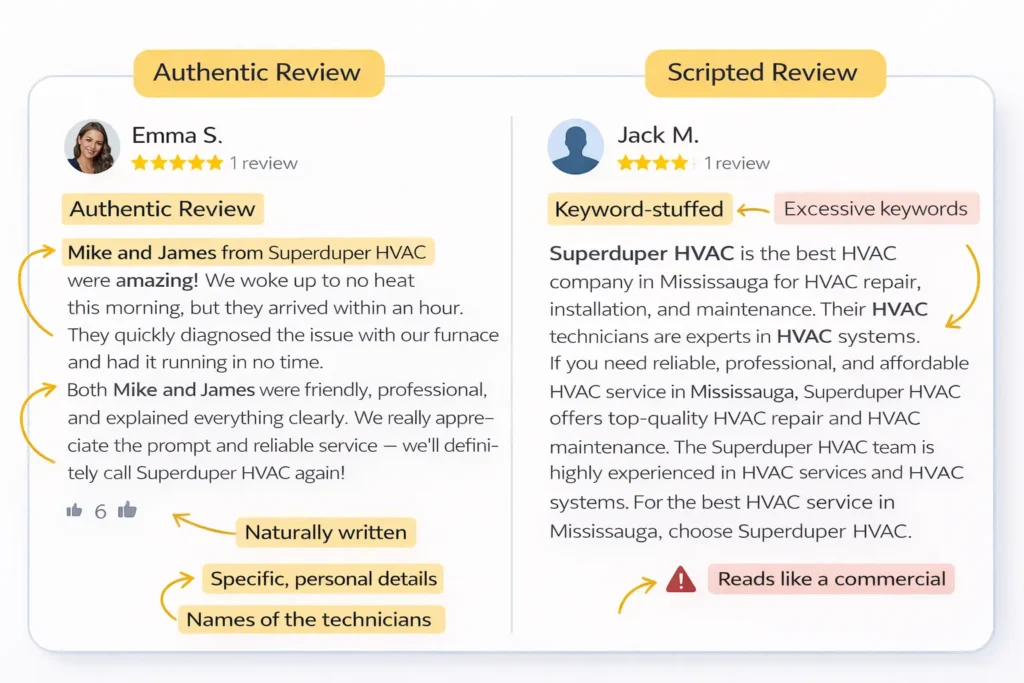
A persistent myth in local SEO suggests that reviews containing specific keywords (“best HVAC company in [city]” or “furnace repair [location]”) provide direct ranking benefits. This belief has led some contractors to coach customers on what to write or even provide scripts for reviews.
Here’s the reality: while Google’s systems do analyze review content to understand what services a business provides, there’s no evidence that keyword-stuffed reviews provide meaningful ranking advantages over naturally written ones. What’s more important—and what can backfire—is the risk of appearing manipulative.
Reviews that sound scripted, contain unnatural language, or suspiciously repeat the same phrases across multiple customers can trigger algorithmic filtering. Worse, they can undermine trust with potential customers who recognize them as coached or fake.
The safe guidance:
- Don’t coach customers on what to write
- Don’t provide scripts or suggest specific language
- Do make it easy for customers to leave reviews (direct links, simple process)
- Do ask soon after service when the experience is fresh and detailed recall is natural
Authentic reviews written in customers’ own words—even if they don’t mention your target keywords—provide both ranking and conversion value that manufactured reviews cannot replicate.
What Backfires: Review Tactics to Avoid
The stakes around review manipulation have increased substantially. Google has intensified enforcement against fake and manipulated reviews, with consequences ranging from review removal to profile penalties and even legal referrals in severe cases.
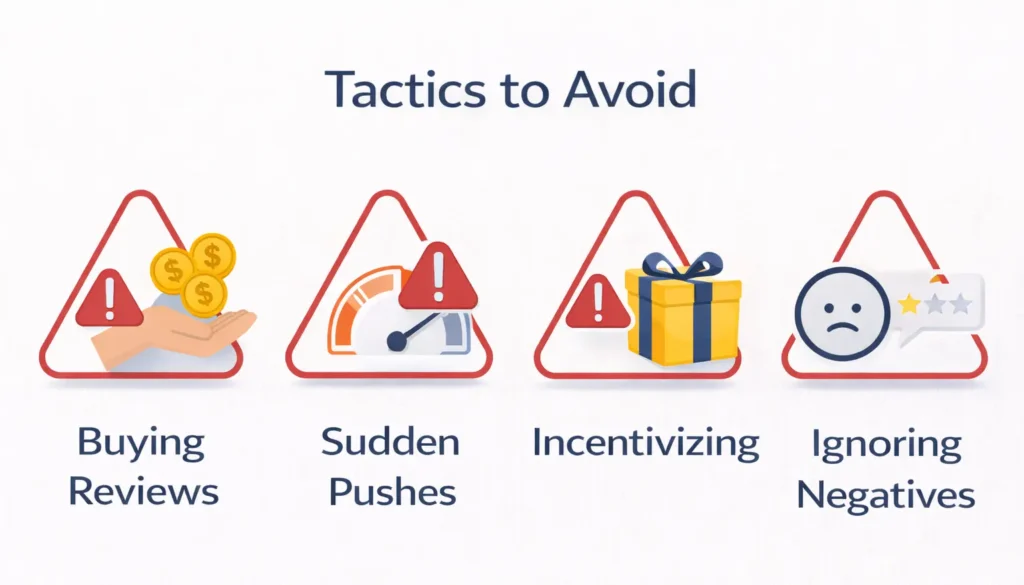
Don’t Buy Reviews
Purchased reviews are easier to detect than most contractors realize. Google’s systems analyze reviewer behavior patterns, timing, IP addresses, and numerous other signals. The short-term ranking benefit is far outweighed by the risk of having reviews stripped and your profile penalized.
Don’t Do “25 Reviews Overnight” Pushes
Sudden influxes of reviews trigger spam detection algorithms. Even if the reviews are genuine, an unnatural pattern can result in reviews being filtered or flagged for manual review. Gradual, consistent review generation is both safer and more effective.
Don’t Incentivize Review Content or Ratings
Google explicitly prohibits incentivizing reviews with discounts, contest entries, or rewards contingent on leaving feedback. Beyond policy violations, incentivized reviews tend to be less detailed and authentic, undermining their conversion value even if they avoid detection.
Don’t Ignore Negative Reviews
While a single negative review won’t destroy your ranking if you have a solid overall profile, leaving negative reviews unanswered creates problems. Potential customers reading your reviews notice when complaints go unaddressed. Professional responses that acknowledge concerns and offer resolution demonstrate accountability—and that public demonstration matters for conversion.
HVAC Competitive Benchmarking: How to Assess Your Market
Rather than chasing arbitrary review targets, the most useful approach is benchmarking against your actual local competitors. Here’s a simple framework:
Step 1: Identify Your Map Pack Competitors
Search for your primary service keywords (e.g., “HVAC repair [your city],” “furnace installation [your city]”) and note which three competitors appear in the Map Pack. These are the businesses you’re directly competing against for local visibility.
Step 2: Analyze Their Review Profiles
For each competitor, document:
- Total review count
- Average star rating
- Recency of their most recent reviews (when was their last review?)
- Review velocity (approximately how many reviews per month?)
- Response behavior (do they respond to reviews? How quickly? How professionally?)
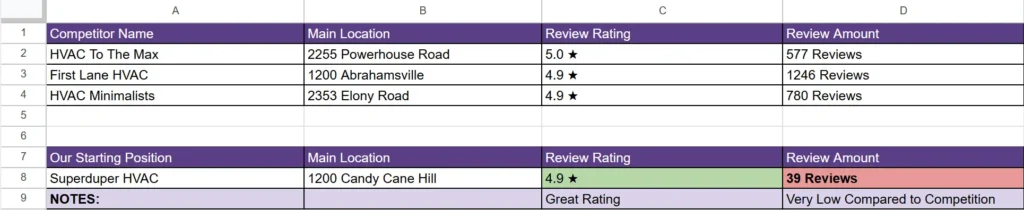
Step 3: Identify Your Review Gap
Compare your profile to the top performers. Where are you behind? Is it total volume? Velocity? Recency? Response rate? This analysis tells you where to focus your efforts.
Step 4: Set Realistic Targets
If your top competitors have 150 reviews and you have 40, closing that gap won’t happen overnight. Set incremental targets—perhaps reaching 75 reviews within six months while maintaining steady velocity. Progress toward competitive parity matters more than achieving arbitrary numbers.
Reviews Affect Visibility, Clicks, and Calls
One of the reasons reviews have become so influential is that they affect multiple stages of the customer journey, not just ranking alone.
Visibility (Ranking)
As we’ve discussed, reviews are a core prominence signal that directly influences Map Pack ranking. More reviews, consistent velocity, and strong ratings all contribute to appearing in those top three positions.
Click-Through Rate
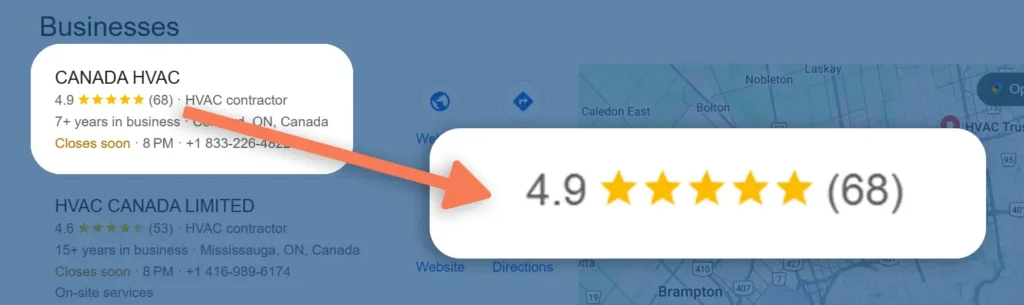
Even after appearing in the Map Pack, your review profile influences whether searchers click on your listing. Star ratings and review counts are visible directly in the Map Pack results. A 4.8-star rating with 150 reviews naturally attracts more clicks than a 4.2-star rating with 30 reviews.
Conversion to Calls
Once a potential customer clicks through to your profile, they often read recent reviews before deciding to call. This is where review content and recency matter most for conversion. Recent positive reviews describing experiences similar to what the customer needs provide the final trust signal that triggers the call.
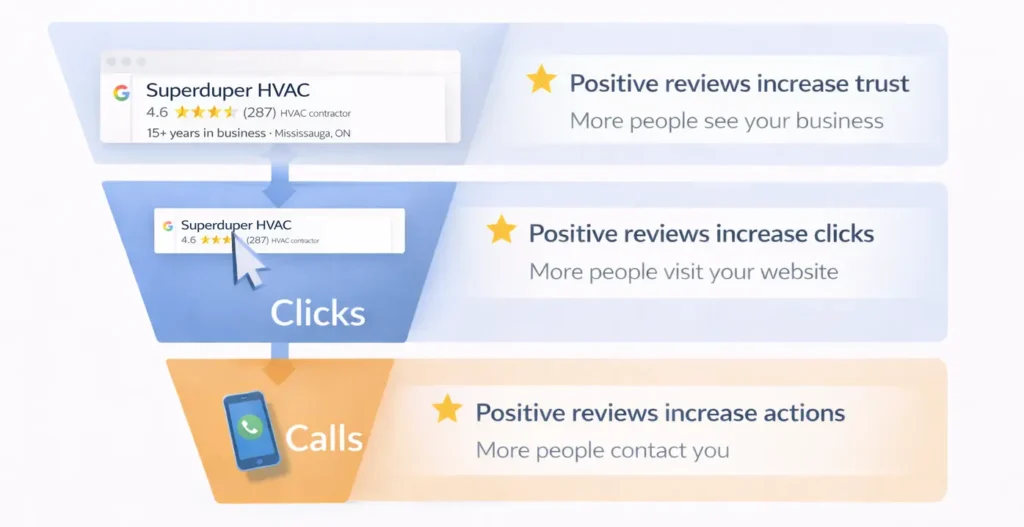
This multi-stage influence means that improving your review profile doesn’t just move rankings—it compounds visibility improvements with higher click rates and better conversion, creating multiplicative returns on the same effort.
What to Do Next
Understanding the review mechanism is the first step. Implementing a systematic approach to review generation and management is where the value is realized.
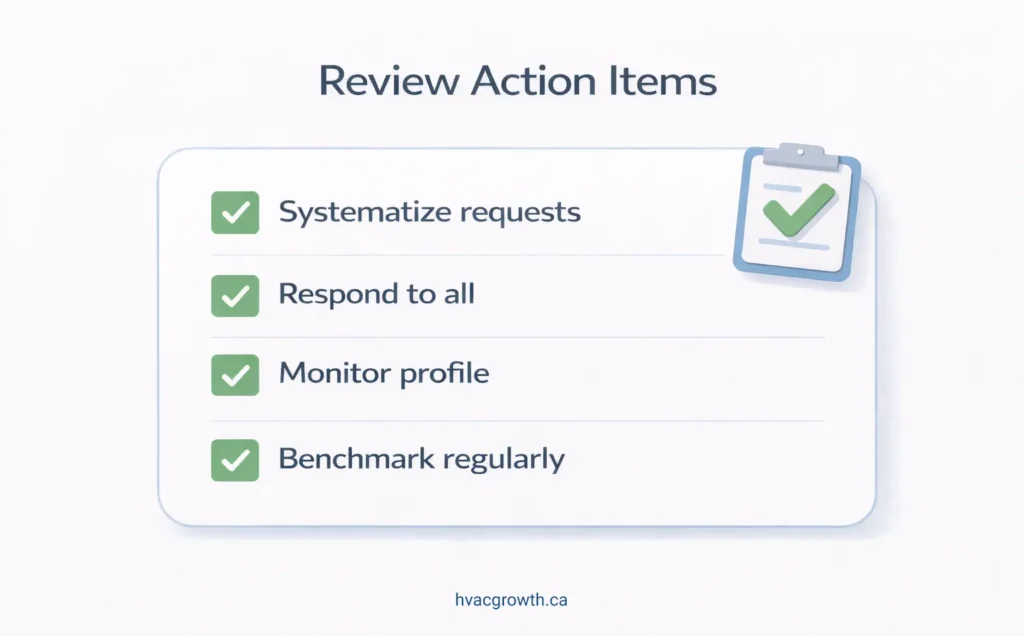
Key areas to focus on:
- Systematize review requests: Integrate asking into your service completion process so it happens consistently, not sporadically
- Respond to all reviews: Positive reviews deserve thanks; negative reviews require professional, resolution-focused responses
- Monitor your profile: Watch for reviews disappearing, unusual patterns, or competitor activity that might require attention
- Benchmark regularly: Revisit your competitive analysis quarterly to ensure you’re maintaining or improving your position
Reviews are one component of a larger local visibility system that includes your Google Business Profile optimization, website performance, citation consistency, and ongoing content strategy. Each element reinforces the others. Contractors who approach these as an integrated system rather than isolated tactics consistently outperform those chasing individual optimizations.
The path forward isn’t complicated, but it does require consistency. Reviews reflect the experience you deliver to customers. If that experience is genuinely good and you make it easy for satisfied customers to share feedback, the reviews—and the visibility they create—follow naturally.
Frequently Asked Questions
Google reviews influence Map Pack rankings primarily through the “prominence” pillar of its local ranking algorithm. Reviews signal business activity, customer validation, and trustworthiness—key factors Google uses to determine which contractors appear in those top three local results. Review signals now account for approximately 20% of all Local Pack ranking factors, making them the second-most influential category after Google Business Profile signals.
No. While Google’s systems do analyze review content to understand what services you provide, there’s no evidence that keyword-stuffed reviews provide ranking advantages over naturally written ones. Coaching customers on what to write or providing scripts can trigger algorithmic filtering and undermine trust with potential customers who recognize them as inauthentic. The safer approach is making it easy for customers to leave honest reviews in their own words.
Avoid buying reviews (detectable through behavior patterns and timing), generating 25+ reviews overnight (triggers spam filters), incentivizing reviews with discounts or rewards (violates Google policy), and ignoring negative reviews (signals unaccountability). Even genuine reviews in unnatural patterns can be filtered. Professional responses to complaints demonstrate accountability and improve conversion even if they don’t directly boost rankings.
Rather than chasing arbitrary numbers, benchmark against your actual Map Pack competitors. Top-ranking HVAC contractors often have 80+ reviews, while average Local Pack businesses maintain around 47. If competitors have 150 reviews and you have 40, set incremental targets—perhaps 75 within six months—while maintaining steady velocity. Closing gaps gradually matters more than hitting specific numbers overnight.
Five specific variables drive ranking impact: review volume (total count), velocity (pace of new reviews), recency (how fresh reviews are), rating distribution (typically 4.5+ stars performs well), and review content (naturally mentioning services). Steady, consistent review generation outperforms sudden spikes—contractors receiving 2-5 new reviews monthly typically see better results than those running aggressive “review pushes” followed by silence.

Take the first step toward calm, connected parenting
Book a free growth call and discover what's possible for your business.
Book Your Free Call